
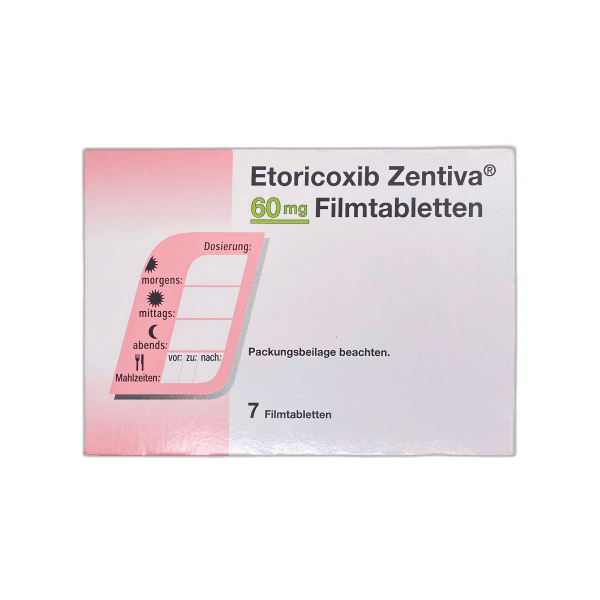
What is etoricoxib?
Etoricoxib is a highly selective COX-2 inhibitor of the newer generation. The original product is Arcoxia®. The active substance has a particularly long half-life and has to be taken only once a day.
Etoricoxib is used in osteoarthritis, rheumatoid arthritis, gout attacks, Morbus Bechterew and for a short time in moderate tooth pain after operations.
Like all COX-2 inhibitors, Etoricoxib has the advantage of less straining the gastrointestinal tract than classic NSAR.
Active Ingredients & Mechanism of Action
Active ingredient: Etoricoxib
Etoricoxib inhibits highly selective cyclooxygenase-2 (COX-2):
Selectivity:
- Etoricoxib is about 100 times more selective for COX-2 than for COX 1
- This is one of the most selective COX-2 inhibitors
Pharmacokinetics:
- Effect entry: about 30 minutes
- Maximum plasma concentration: 1–2 hours
- half-life: about 22 hours
- Once daily intake sufficient
Wirkprofil:
- Strong pain relief
- Strong anti-inflammatory
- Particularly effective in acute inflammatory conditions (Gicht)
Who is it suitable for?
Etoricoxib is suitable for:
- Arthrosis (60 mg)
- Rheumatoid arthritis (90 mg)
- Morbus Bechterew (90 mg)
- Acute gout attack (120 mg)
- Short-term: moderately strong tooth pain after surgery (90 mg)
Especially suitable for:
- Patients with GI-risk (magic protection desired)
- Gout attacks (fast, strong effect)
- Patients who prefer a daily intake
Not suitable:
- In existing cardiovascular disease
- In case of uncontrolled high blood pressure > 140/90 mmHg
- In severe liver or kidney failure
Available Dosages
Tablets:
- 30 mg, 60 mg, 90 mg, 120 mg
Indication-related dosage:
- Arthrosis: 30–60 mg once a day
- Rheumatoid arthritis: 90 mg once a day
- Morbus Bechterew: 90 mg once a day
- Acute gout attack: 120 mg once a day (max. 8 days)
- toothache (post-OP): 90 mg once a day (max. 3 days)
Maximum daily dose: 120 mg
How to Take
Intake:
- Once a day, regardless of meals
- Take a tablet with water
- Possible every day at the same time
Important notes:
- Control blood pressure regularly (Etoricoxib can increase blood pressure)
- Use the lowest effective dose
- At gout: start treatment at attack, max. 8 days
- Do not combine with other NSAR
Contraindications
**Etoricoxib must not be taken at:* *
- hypersensitivity to etoricoxib
- Active gastrointestinal ulcers or bleeding
- Ichaemic heart disease, heart failure (NYHA II–IV)
- Uncontrolled high blood pressure (> 140/90 mmHg)
- condition after heart attack or stroke
- Heavy liver failure
- Heavy renal insufficiency (Kreatinin-Clearance < 30 ml/min)
- Pregnancy and breastfeeding
- Children and young people under 16 years of age
Preview at:
- Cardiovascular risk factors
- Easy to moderate kidney function disorder
- Edema
Possible Side Effects
Family (1–10 %):
- High blood pressure (more frequent than other NSAR)
- headache, dizziness
- Gastrointestinal complaints (abuse, heartburn)
- Edema
- fatigue
** Occasionally (0.1-1 %):* *
- Heart failure
- Increased liver levels
- Skin rash
Selten, but seriously:
- Cardiovascular events
- Heavy skin reactions
- liver damage
Blow pressure increase: Etoricoxib can increase blood pressure more than other NSAR. Regular control is important.
Interactions
Increased bleeding risk with:
- Anticoagulants (Warfarin – INR control)
- ASS (low dose)
Sustainability of:
- ACE inhibitors, sartans
- Diuretics
Elevated mirrors of:
- Lithium
- Methotrexate
Preview with:
- Oral contraceptives (Etoricoxib can increase ethynylestradiol levels)
- Rifampicin (senkt Etoricoxib-Spiegel)
Frequently Asked Questions
Similar Medications
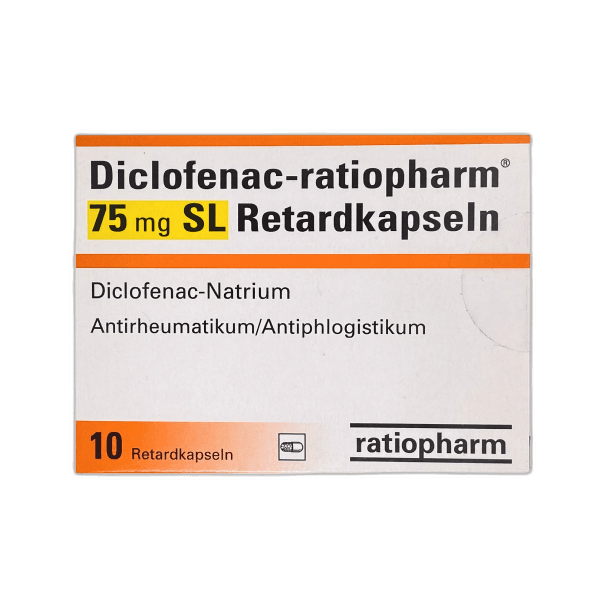
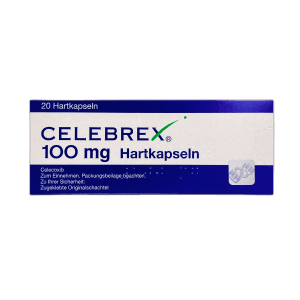
Is etoricoxib right for you?
A licensed doctor will review your information and issue a prescription if suitable. Discreet and secure.
Important Notice
This information does not replace medical advice. If you have questions about your health or the suitability of this medication, please consult a doctor. Read the package leaflet before use.