
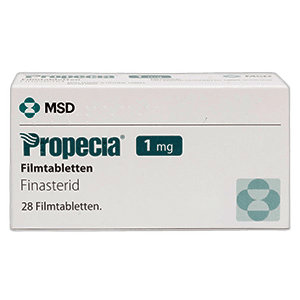
What is finasteride?
Finasteride is a prescription active ingredient for the treatment of inherited hair loss (androgenic alopecia) in men. The drug was originally introduced by MSD under the brand name Propecia® and is now available as a generic by various manufacturers.
The active ingredient belongs to the group of 5-alpha reductase inhibitors. It specifically intervenes in the hormonal mechanism responsible for hair loss, and can stop hair loss as well as reactivate hair growth in many men.
Important to know: Finasterid is only allowed for men. For women, the drug is not suitable and can lead to severe malformations in male fetus, especially during pregnancy.
The effect does not apply immediately – first results are usually visible after 3 to 6 months, the full effect after about 12 months.
Active Ingredients & Mechanism of Action
Active ingredient: Finasterid
In order to understand the effect of finasteride, one must know the mechanism of the hereditary hair loss:
The background: The male sex hormone testosterone is converted into dihydrotestosterone (DHT) in the body by the enzyme 5-alpha reductase. DHT is a potent androgen that damages the hair follicles on the head in genetically predisposed men. The follicles shrink, the hair becomes thinner and finally fall out.
**The effect of Finasterid:* * Finasteride inhibits the enzyme 5-alpha reductase (type II) and thereby reduces the DHT concentration in the blood and in the scalp by about 70%. With less DHT, the hair follicles are protected:
- The hair loss is stopped at about 90% of users
- New hair growth shows about 65% of users
- The hair quality improves – existing hair becomes stronger
Language: The effect is slowly expanding. First visible results after 3-6 months, optimal effect after 12-24 months. If finasteride is removed, the hair loss returns within 12 months.
Who is it suitable for?
Finasteride is suitable for:
Men with androgenic alopecia:
- Typical pattern: Secret Council corners and/or light spot at the top
- Age: 18-41 years (study population), even older men can benefit
- Light to medium hair loss (best results)
- Even with advanced hair loss possible, expectations should be adjusted
Especially effective at:
- Early intervention – the earlier treatment begins, the better
- hair loss mainly on the vertex
- Still existing, even thinned hair
More suitable for:
- Completely stealed places (there are no more follicles to save)
- Hair loss at the temples (lower effectiveness)
- Women (not allowed, can cause malformations in male fetus)
- scar or disease-related hair loss
Combination therapy: Finasteride is often combined with minoxidil. Both active ingredients have different mechanisms and can complement each other.
Available Dosages
For androgenic alopecia:
- 1 mg per day – Only allowed dose for hair loss
Other dosages (not for hair loss):
- 5 mg is used for treating benign prostate enlargement
- This higher dose is not required for hair loss and increases the risk of side effects
Application duration:
- Long-term therapy required
- The intake must be carried out continuously to obtain the effect
- When settling, hair loss returns within 12 months
- After 5 years of application, studies continue to show good effectiveness
Pack sizes: Finasteride 1 mg is available in various pack sizes (28, 84, 98 tablets), with larger packs usually being more economical.
How to Take
Intake:
- One tablet (1 mg) daily
- With or without meal
- Take water with a glass
- Possibly at the same time of day for even active mirrors
Important notes:
- Do not divide or chew the tablets
- Pregnant women should not touch the tablets (active substance absorption possible via the skin)
- Forgot intake: Just continue normal the next day, no double dose
Language and expectations:
- 3-6 months: First results may be visible, hair loss slows
- 12 months: Full effect assessed, visible in many men denser hair
- Long term: Continuous intake needed to get results
What you can expect:
- Hair loss stops at about 90% of men
- Visible growth at about 65 %
- The effect is best on a crown and a backhead
- At the secret council corners usually lower effect
Contraindications
Absolute contraindications:
Women:
- Finasterid is only allowed for men
- In pregnant women it can lead to severe malformations of the genitals of male fetuses
- Even skin contact with broken tablets should be avoided
Children and young people:
- Not for persons under 18 years
Insensitivity:
- Known allergy to finasteride or any of the other ingredients
**Relative contraindications – special care with:* *
Leberfunction disorder:
- Finasteride is mined in the liver
- In case of severe liver disease, excretion may be delayed
Psychical preload:
- When leaning towards depression or anxiety, tight-mesh observation recommended
- When mental symptoms occur inform doctor
Prostate cancer screening:
- Finasteride reduces the PSA value by about 50 %
- This must be taken into account in prostate cancer prevention
- inform doctor about the Finasterid intake
Possible Side Effects
**Family side effects (1-10%):* *
- Reduced libido (sexual desire)
- Erectile dysfunction
- Reduced ejaculate volume
**Other side effects (0,1-1%):* *
- Depressive detunement
- sensitivity or swelling of the breast
- Skin rash
**Setting side effects (less than 0.1%):* *
- Sensitivity reactions
- Increased liver enzymes
- testicular pain
Post-Finasteride Syndrome: In rare cases, men report on persistent sexual side effects even after decommissioning. This post-finasteride syndrome is scientifically controversial and is further researched. The frequency is very low.
Important notes:
- Most sexual side effects disappear on continuation of therapy or after decommissioning
- In case of persistent or stressful side effects, treatment should be terminated
- Mental changes (depressions) should be taken seriously
Influence on laboratory tests:
- PSA value decreases by about 50% – important for prostate cancer care
Interactions
Reactions: Finasteride has relatively few clinically relevant interactions:
**No known significant interactions with:* *
- Blood pressure medications
- cholesterol cores
- Diabetes drugs
- Painkillers
Theoretical interactions:
- CYP3A4 inhibitor (Ketoconazole, Ritonavir): Could slow down the degradation of finasteride, but not relevant
- Johanniskraut: Could accelerate degradation, meaning unclear
Special Notes:
PSA test: Finasteride reduces the PSA value by about 50%. In prostate cancer prevention, the doctor must know this to interpret the values correctly.
Blood donation: During taking and until a month after putting off, men should not give blood, as the blood could theoretically be transferred to pregnant women.
Pregnant partners: In the event of a child's request or pregnancy of the partner: Finasterid passes into the seed liquid in small amounts. The risk for the fetus is considered very low, but should be discussed with the doctor.
Frequently Asked Questions
Similar Medications

Is finasteride right for you?
A licensed doctor will review your information and issue a prescription if suitable. Discreet and secure.
Important Notice
This information does not replace medical advice. If you have questions about your health or the suitability of this medication, please consult a doctor. Read the package leaflet before use.